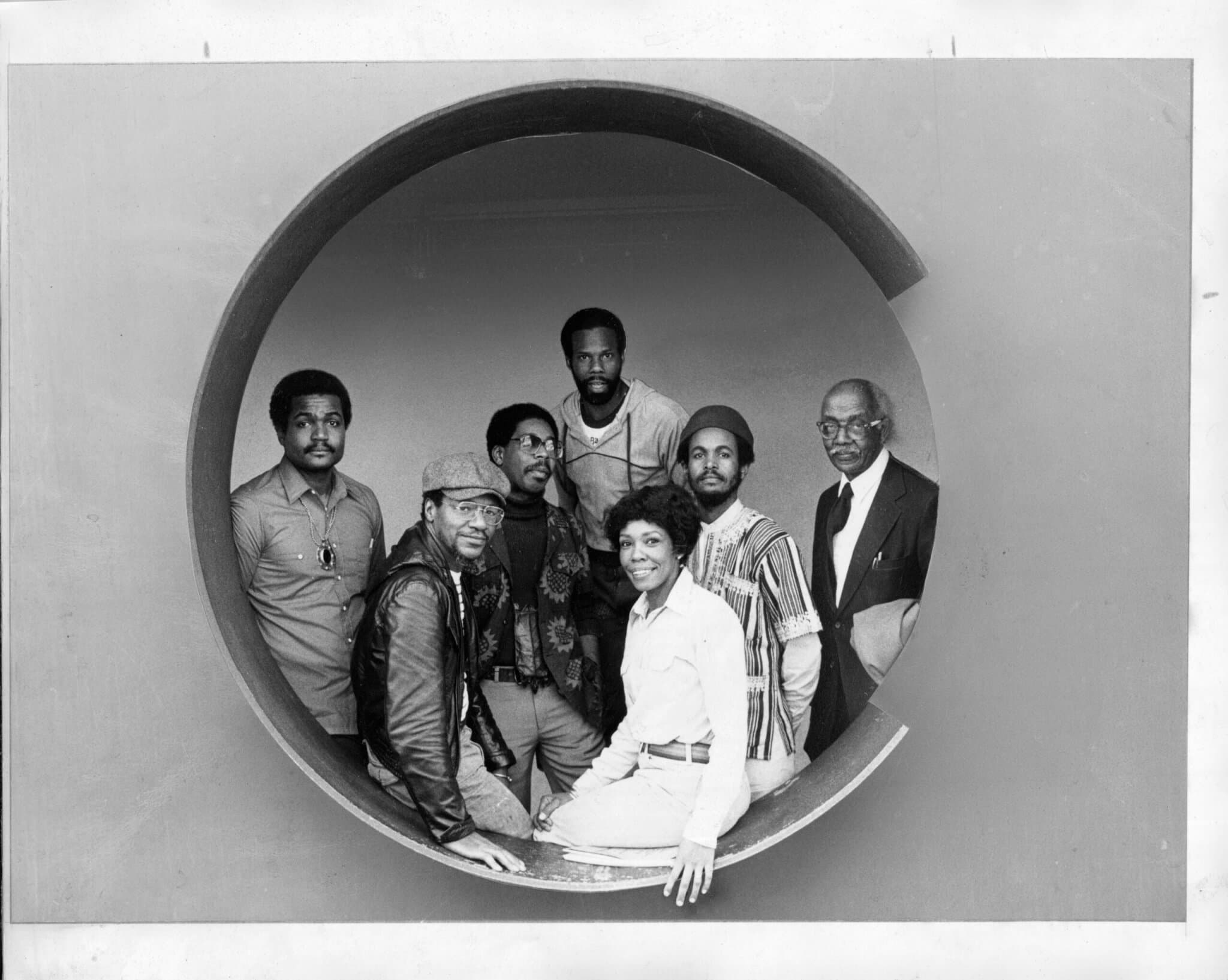
“What happened in Boston between 1979 and 1989 was a major Black Arts renaissance,” artist Aukram Burton recalls with conviction and pride. This statement took a minute to sink in as I chatted with Burton to piece together the history of a now little-remembered artist group called the Boston Collective. While most of us today might struggle to remember major Boston art movements from those years or consider the city a vital home for Black art creation, the 1980s were, in fact, dynamic years of exceptional creative energy. They were an important link between the self-consciously Black art of the 1920–30s, the Black Arts Movement of the 1960s, and twenty-first-century art. In Boston during the 1980s, key figures from multiple generations formed a supportive environment where the visual arts thrived, and the Boston Collective was at the center of this renaissance. They gained regional, national, and international visibility, culminating with a major exhibition in China in 1986.
The Collective was a group of younger artists who orbited around the significant force that was Allan Rohan Crite (1910–2007). His career spanned nearly the entire twentieth century; artist Napoleon Jones-Henderson commented, “I learned about Mr. Crite’s work from the history books.” When Jones-Henderson moved to Boston, he was surprised to discover that Crite was alive and working. Crite had made his mark in the 1930s and 1940s, painting urban street scenes of middle-class African Americans in his neighborhood in the South End to counter pervasive negative racial stereotyping. In the 1980s, Crite was still painting and, understanding the importance of mentorship, sought out an art family to nurture.
The artists involved in the Collective came from different backgrounds but found themselves here, in Boston, at the right place and time. Burton, a documentary filmmaker and photographer, came from Philadelphia and became a teacher of photography and video production at a media magnet high school. Jones-Henderson, a textile artist and founding member of AfriCOBRA (the African Commune of Bad Relevant Artists), moved to Boston from Chicago in 1974, to teach at MassArt. The same year, Reginald Jackson, a photographer, relocated from New York to run the photojournalism department at Simmons College. Lotus Do, a painter, also moved from New York in the mid-1970s and taught in the Boston Public Schools in Columbia Point. Multimedia artist Johnetta Tinker grew up in Boston and moved back home after completing a degree at Texas Southern University with John Biggers. Dennis Didley—aka Vusumuzi Maduna, better known simply as Vusi—was a sculptor born and raised in Cambridge. The two who grew up in Roxbury were Paul Goodnight, a painter, and Susan Thompson, a textile artist.
These artists developed a creative practice in Boston because there were teaching opportunities and newly formed art spaces where they could work and exhibit. Vital among these was the African American Master Artists-in-Residency Program (AAMARP) at Northeastern, founded by Dana Chandler in 1977, where Jackson had a studio. Goodnight, Tinker, Vusi, and Burton had affordable live-in studio spaces at the Pianoforte Manufactory building—better known as the Piano Factory—which opened to tenants in 1974. In addition, there were critical community-based organizations that actively exhibited art, like the National Center of Afro-American Artists (NCAAA), established in 1968 by Elma Lewis and run by significant force Edmund Barry Gaither, and the Harriet Tubman Gallery, which opened at the United South End Settlements in 1979. A lot was going on in Boston, and these artists and cultural creators did not wait for storied institutions to take notice; they made their own opportunities and communities.
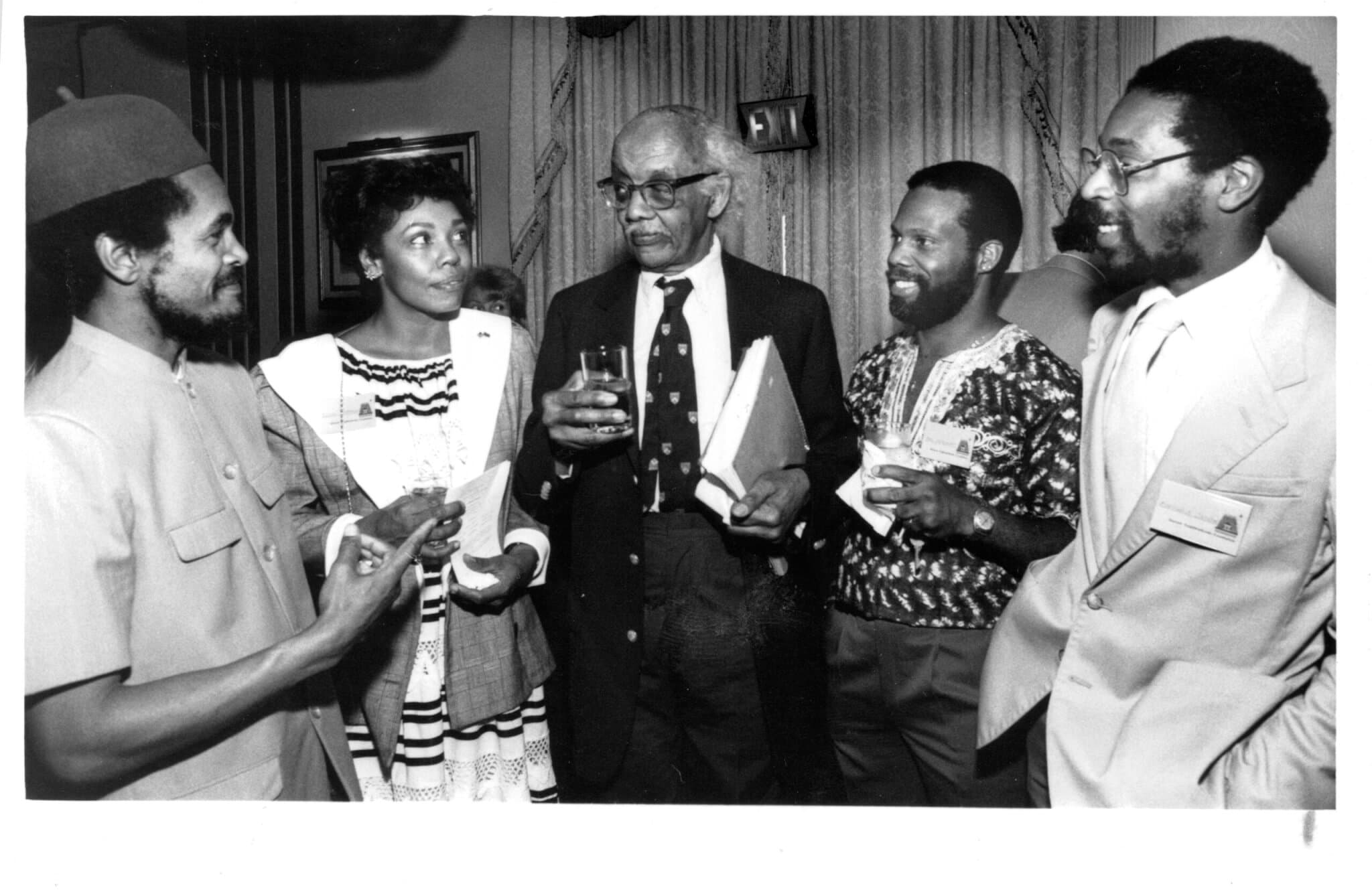
Many have recounted the story of how the Collective came together. After Crite’s mother, Annamae Palmer Crite, passed away in 1977, Crite started going out and attending openings. Jones-Henderson remembers, “When he was free from the restraints of caring for his mother, he really started to connect with artists. He spread his wings and flew.” But he did not fly away; instead, Crite found his flock. Indeed, a 1982 Boston Globe article about an early Collective show describes Crite as looking “a bit out of place, seated with his glass of ginger ale at cocktail tables occupied by much younger artists” but “right at home seated beneath his works on display upstairs” at the opening at the Harriet Tubman Gallery.
The Boston Collective’s name speaks to the group’s geographic specificity and broad, multicultural connection. The Collective embraced diversity by many definitions—gender, race, background, and artistic style—and their work encompassed a multitude of cultural influences from the African Diaspora, Europe, and Asia. The group quickly grew to absorb new members from an all-female initiative called What In The World, comprising Johnetta Tinker, Lotus Do, Weeta Lopes, and Susan Thompson. Do, whose heritage includes Dutch and Vietnamese ancestors, remembers likening the assembling of the group to a jazz piece: “All of us in the Collective were doing our own thing, improvising, and everyone would stop, listen, and praise that person for what they were doing. Then the next person would do something else. It was all like one group piece, but individual.” Indeed, Jackson and others in the Collective thought of Crite as an artistic father figure and reminisced that Crite would say, “I have seven disgruntled sons and three or four daughters all going in different directions, but all creating.”
Yet an aesthetic language connected the group across media and approaches. Following Crite’s lead, these younger artists’ work were grounded in politically and spiritually driven figuration. This common language emerged out of the intensity of dialogue. They would meet at one another’s studios, houses, and events as often as possible. Most importantly, they would show up for one another. Crite infused the group with generosity and care that rippled out through each Collective member.
Underpinning the group’s discussions and artwork was Crite’s philosophical understanding of multiculturalism, which directly connected to the ideas of cultural pluralism developed by W. E. B. Du Bois and Alain Locke at the beginning of the twentieth century. Crite—a profound thinker and serious scholar—considered the continuum of cultural expressions across time and place and how humanity is fundamentally interconnected through ancestral roots. Much like diversity, equity, and inclusion are buzzwords today, multiculturalism was the hook term these ideas hung on in the late 1980s and 1990s. But the Collective was ahead of the cultural debates by practicing multiculturalism.
This interest in understanding the intersectional diversity of underrepresented peoples led the Collective to travel to China and have its first and only major art exhibition abroad, called “Contemporary Images.” To comprehend how the Collective’s work came to be shown in Guangzhou, China, in the summer of 1986, we need to go back to a critical meeting between Burton and Crite in 1977, before the Collective had even formed.
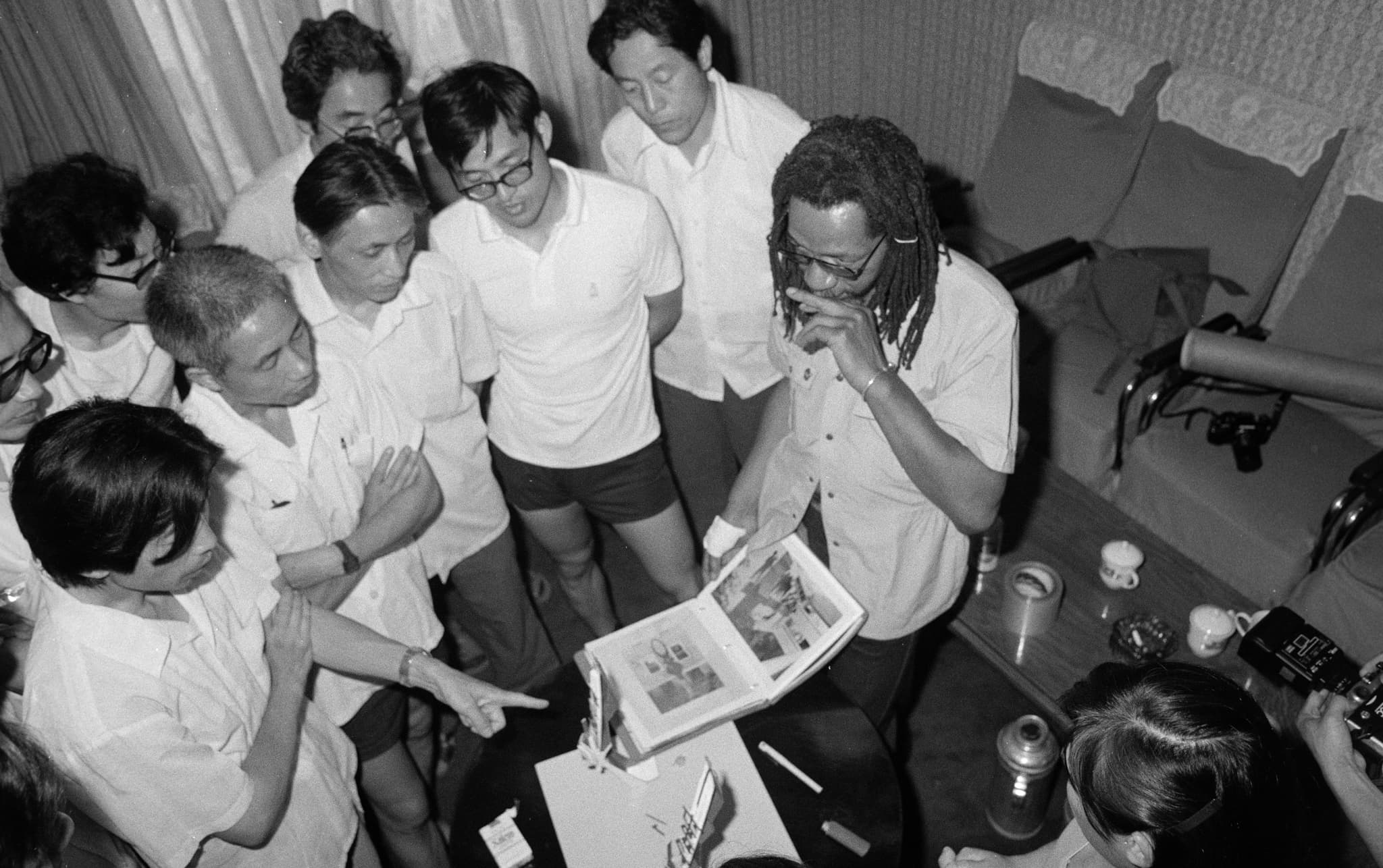
Burton had just returned to Boston from his first trip to China as an official photographer for the US-China Peoples Friendship Association as the two nations worked toward establishing official diplomatic relations. Part of the funding Burton received was to give presentations of his travels back home, and “on a wet and cold, rainy December day,” as Burton remembers, he held one such lecture at the Mattapan Public Library. Crite, who was in the audience, expressed interest in visiting China, and Burton remembers replying, “Maybe one day we will do that.” Fast forward nine years to the summer of 1986, and Crite and Burton, along with other Collective members, including Do, Vusi, Thompson, Tinker, and Burton’s wife Nefertiti, set out to visit China together and show the Collective’s work in an exhibition that had major political and social consequences.
The Collective’s trip to China was for more than just the exhibition; it was a research opportunity. Burton, Crite, and others were interested in learning from China’s minority communities. Since the 1950s, the Chinese Communist Party had pursued an ethnic classification project that resulted in the recognition of more minority peoples than under any other regime in the nation’s history, a strategy meant to neutralize divisions instead of negating them. Burton, Crite, and Thompson had been involved with the Massachusetts Institute of Technology Community Fellows Program, a mid-career leadership program for individuals with distinguished records as community practitioners under the auspices of the Department of Urban Studies and Planning. Through this program, the three went to China in 1983, setting the stage for the goals of the Collective’s 1986 trip and exhibition.
Funding and support for the Collective’s second trip materialized thanks to fortuitous geopolitical circumstances. Given the recent establishment of diplomatic relations in 1979, Massachusetts Governor Michael Dukakis had been working toward forming business and economic opportunities, and the arts were a vehicle for creating those connections. Knowing that the governor’s office was looking for artists to propose a cultural exchange, Burton and Crite were well positioned—thanks to their 1983 trip—to put forward the Collective’s cultural proposal, which included the exhibition “Contemporary Images.” The Collective’s travels and exhibition were fully funded through the state’s International Trade and Investment Office and the Massachusetts Council on Arts and Humanities. Theirs was the first state-sponsored Chinese-American exchange of artists.
The Collective’s itinerary in China was extensive, and they traveled around the country by bus, train, and airplane from Shanghai to Hangzhou, traveling nearly nine hundred miles south to Guangzhou, Guangdong Province, the sister state to Massachusetts. Everywhere they went, Crite was sketching. He was notorious for never going anywhere without paper and a pencil. It was his way of recording what he saw and processing his experiences. Crite drew farmers working the fields and inhabitants in the streets, as well as legends and myths the locals shared, and sometimes members of the Collective just hanging out. Others, like Tinker, who started using ink drawing techniques in her work, were likewise profoundly impacted by the trip.
Along the way, the Collective met people and visited sites of historic and artistic importance. Do said, “It was fascinating to see how the people were interested in different modes of economic freedom. They were curious about our American sneakers. Tinker would say that they were looking at us because we are Black, and I would say, I think they are looking at us because of the sneakers we have on and maybe also because you guys are Black.” And while they remembered feeling self-conscious, the Collective members were also excited to learn, share, and experience.
Unfortunately, crucial information about the exhibition “Contemporary Images” is still buried in the archives of those who participated. Burton recalls that each Boston Collective artist exhibited more than one example of their work in a show that was mounted for over two weeks at the Guangzhou Academy of Fine Arts in June 1986. It was the institute’s first Western exhibit and was advertised and open to the public. Thompson recollects that it was very popular and visitors were receptive to the work. She was informed that some people came from miles away on bicycles to visit the exhibition and meet the artists.
In a Boston Globe article covering the trip, Crite recounted his opening remarks in Guangzhou: “‘There is a tendency to think of American heritage in European terms, but African tradition is part of the heritage of all Americans. All of us have some Africanism in our work.’ He told the Chinese artists of his long-standing belief that to ‘understand ourselves, we must also be aware of our cultural roots in Asia and Africa.’”
Enriched by this multicultural experience, the Collective artists exhibited the work they created in China in Boston upon their return. At the Crite House Museum, they showed photographs, sketches, drawings, and paintings of their experiences. The cultural exchange also brought Chinese artists and cultural leaders to Boston. Six faculty members from the Guangzhou Academy of Fine Arts visited and had an exhibition of their work at the Bunker Hill Community College Art Gallery in Charlestown. Members of the Collective hosted their Chinese counterparts for a number of other events in the city and coordinated programs in a half dozen communities around the state to celebrate the Massachusetts-Guangdong exchange.
Now, almost forty years later, we can take stock of this history, especially as Sino-American relations continue to be complex. During the 1980s, Boston was at the center of a Black and multicultural art movement that put the city on the map nationally and internationally. The Collective was ambitious in seeking a network of opportunities to create and share by finding space for working and exhibiting. Moreover, Crite sought to nurture an art family grounded in love and support, and this legacy lives on through the Collective members still in Boston and their relationships with younger artists who have come to find a home here. Jackson and Thompson, for instance, have been steadfast in maintaining AAMARP despite recent attempts by Northeastern to close the program, and Jones-Henderson has mentored countless younger Black artists, including Chanel Thervil. I also do not doubt that the impact of the Collective also lives on in the members who, for one reason or another, have had to move away. And perhaps, ripples of the Collective’s spirit of generosity, nurtured by Crite, might still be reverberating on the other side of the world in China among those whom the Collective encountered.
This article would not have been possible without the kindness of the Boston Collective members. I thank Aukram Burton, Lotus Do, Reginald L. Jackson, Napoleon Jones-Henderson, Susan Thompson, and Johnetta Tinker for their memories.