Last week was dominated by New York thanks to the one-two arts-and-policy punch of the Armory Show and the 81st session of the United Nations General Assembly (UNGA). I attended neither. This left things a little quiet on the home front.
Here in Greater Boston, artist Josh Kline spoke at MIT, and Spanish Prime Minister Pedro Sánchez spoke at Harvard. Surprisingly, their presentations shared several parallels.
Sánchez’s Harvard Kennedy School talk about the “technoligarch threat to democracy” made the case for combating increasing wealth concentration and regulating AI companies, arguing that states are, for now, still more powerful than AI companies—but only for now. “We have to abandon the fable of self-regulation,” he said during the September 24 talk. “The age of gods and feudal lords is long over. We are not placing the future of humanity in the hands of a few billionaires. We are going to place it where it belongs: in our own hands, in our democratic institutions.” His point, it seems, was that every generation has faced “tycoons” seeking to consolidate and control wealth, and that it’s the job of government and civic society to push back. Now, with AI, the threats posed by wealth concentration spell risks across all levels of society, from the local to the global. What happens in the US doesn’t stay within our borders. The mass immiseration of the working and middle class in the US, Sánchez seemed to imply, is a threat to global order. The previous day, artist Josh Kline’s talk (hosted by MIT’s List Visual Arts Center) about his practice, which focuses on labor, seemed largely aligned with Sánchez’s points, though phrased a la edgelord diplomacy: “The precarity never goes away. You know, even for someone like me, it just never fucking ends.”
Kline pointed out that wealth concentration affects artists in the US by driving up the cost of exhibiting their work. When a curator evaluates whether to include work by a US-based artist or by an artist working somewhere with lower production and shipping costs, they think twice. This puts us in a globalist competition that leaves US-based artists out of the conversation, even if these artists don’t realize it.
Both talks touched on something I have been thinking about a lot over the past few years: What kind of shared risks are created when people are priced out of participating in society?
A year ago, I was on a research trip in Ankara, Turkiÿe, with the German Marshall Fund of the United States, a DC-based think tank. At a meeting with the think tank’s local team, research fellows described a social phenomenon that had them worried: Because of the cost-of-living crisis, “a job is no longer a path out of poverty.” They worried that the situation was causing social instability, as people felt they were falling behind even as they worked, and were priced out of hanging out or dating, let alone major life milestones.
This situation is increasingly similar in the US—and in Boston. The city has one of the widest racial wealth gaps in the nation, a gap that becomes especially striking among underrepresented populations. A recent study found that Black Bostonians born in the US have an overall median net wealth of just $7,800. In 2015, a similar study found that Black Bostonians’ net worth was only $8. While signals suggest things are improving marginally, the significant and growing unmet community needs that arise from Boston’s “tale of two economies” dynamic are often out of sync with the city’s moneyed external reputation.
Creative Labor, Creative Conditions, a national campaign, picked up this affordability-crisis thread during a recent cultural policy event that it hosted in Boston. The summit was part of Company One Theatre’s multiday Boston convening for Creative Labor, Creative Conditions, a local activation of the Doris Duke Foundation’s national initiative focused on the future of artistic labor. The programming mixed closed-door and public sessions, including an invite-only national summit for theater leaders to discuss new models for nonprofit theater and its role in civic life. I attended on September 18, when the focus turned specifically to Boston with “Creative Labor: A Boston Cultural Policy Summit,” developed in collaboration with Arts Activate Boston, a newly launched coalition of local artists and cultural leaders working in arts policy and organizing around arts funding and cultural policy in the city. Notably absent were the local arts power players: the Boston Symphony Orchestra, the Institute of Contemporary Art, the Museum of Fine Arts, and university museums. I also didn’t see anyone from the labor movement.
The program featured Karthik Subramanian, managing director of Company One; David Leonard, president of the Boston Public Library; Ashley Ferro-Murray, program director for the Arts at the Doris Duke Foundation; Giles Li, director of arts + creativity at the Barr Foundation; and Julia Ryan, chief of staff in the Mayor’s Office of Arts and Culture. It also featured a scene from Company One’s play A New Era.
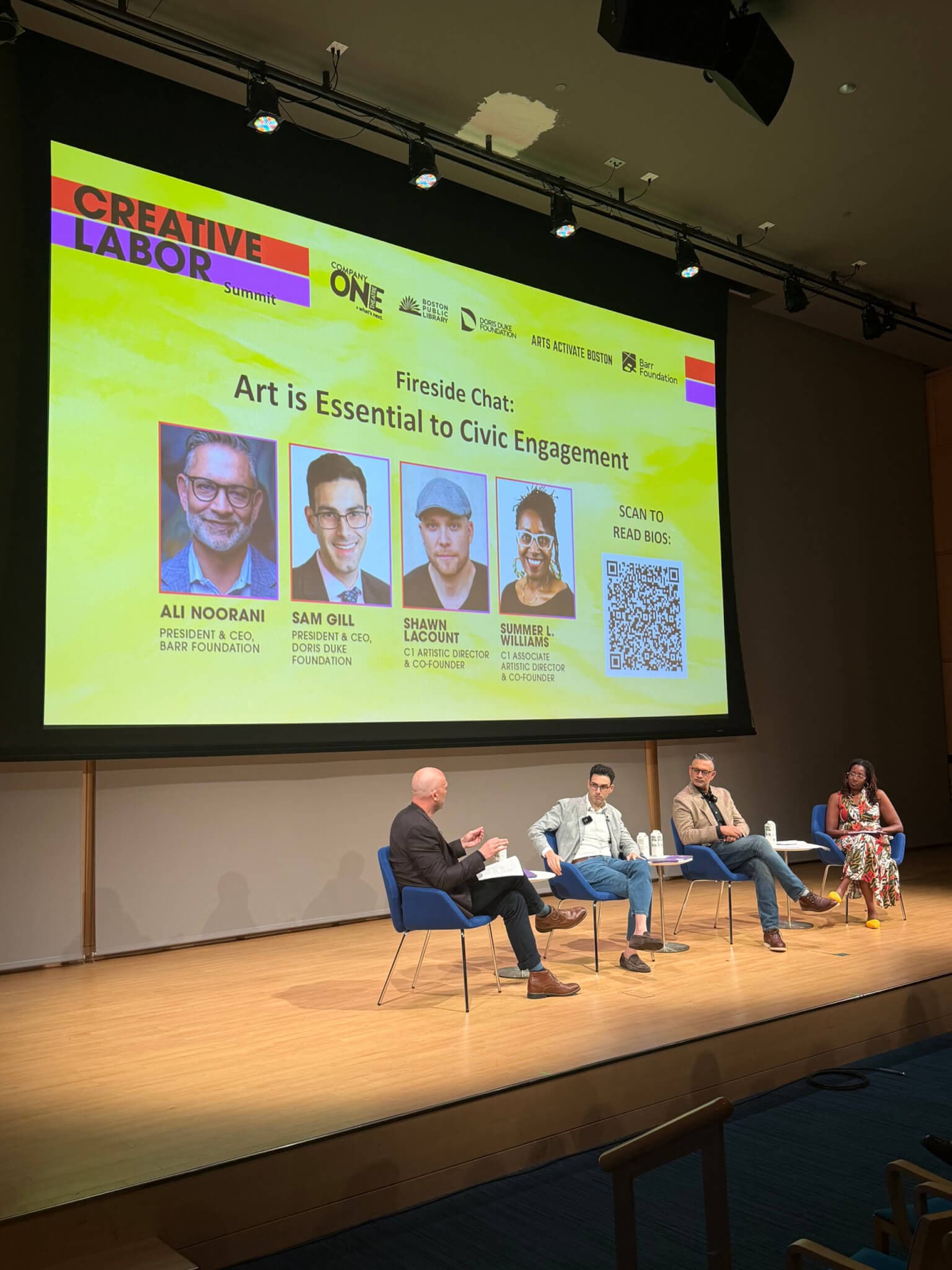
The plenary was a “fireside” conversation between Doris Duke Foundation President and CEO Sam Gill and Barr Foundation President and CEO Ali Noorani, with Company One’s cofounders Summer L. Williams and Shawn LaCount.
It’s fairly rare to hear the heads of philanthropic foundations speak so candidly. I think two points are worth raising.
The first is from Gill: “One of the really challenging economic dislocations that faces the arts is that we want it to be like air and water, and yet we finance it by excluding people from it, through a ticket. I think the answer to getting out of that is to make the arts more essential—is to make it so that we are banging on the doors of the halls of power, saying, ‘We want more of this thing,’” he noted during the conversation. I had to wonder: As young people leave the state, functional unemployment rises, and birth rates decline, are we not seeing people bang on the doors of power? Maybe the banging just isn’t being delivered in a way leaders are hearing it.
The Barr Foundation supports Boston Art Review and my role. Duly disclosed, you may discount the following as you will, but (other than quoting the Breitbart Doctrine’s repackaging of Gramsci, which I wrote about in my inaugural piece for this column), Noorani said something that struck me as a useful unlock for some of the sticking points that have plagued the arts policy space for decades:
“The entire—as I understand it—purpose of this gathering is to start to put a range of stakeholders within the arts sector and beyond the arts sector in a room to start to think about, OK, what is a collective agenda to pressure philanthropy—the private sector—and the public sector to really invest in the arts in the ways that the arts are essential to Boston? It is hard for any one of those sources of capital to say, ‘OK, we will do it this way, if we are sensing … that there is division within the ranks.’”
This is why it’s a problem to have an arts policy agenda—not just at this event, but in the broader context of organizing for the arts—that lacks participation by legacy arts institutions. It signals to the powers of the purse and to policymakers the reality of the field: that the ranks are indeed divided.
After the plenary, three working groups met. The one I attended focused on the Living Wage for All Act, legislation introduced by Rep. Delia Ramirez of Illinois to increase the federal minimum wage to $25 an hour. The working group’s leaders passed out a one-pager about the act. According to MIT’s living wage calculator, the explainer cited, a single person in Boston needs a salary of $125,000 to live comfortably, while artists earn a median of just $15,000 from their main jobs.
I’m not sure what the expectation was for a roughly two-hour talking session, or what the takeaway was supposed to be. But the conversations about the difficulty of passing this act—should tipped workers also receive $25 an hour?—reminded me of the Equal Rights Amendment. Yes, I know passing a constitutional amendment is a totally different process than passing legislation, but I couldn’t help thinking about how legislation supporting something most folks agree with can languish for ages.
The organizers of Creative Labor, Creative Conditions said they will host another convening in December, though it’s unclear how constituents can get involved in the agenda or planning in the meantime. For now, perhaps the aforementioned “banging on the door” should be directed at the stalwart institutions that often set the salary benchmarks in the arts industry.