Iconographic motifs of boxing have been present in art throughout history, dating back to ancient Greece, where they appear in bronze and marble sculptures of idealized male figures. Boxing themes remained popular into the nineteenth century as metaphors of cultural superiority and notions of nationhood. Théodore Géricault’s Boxers, a lithograph dating to 1818, is one such example that frames the boxing narrative as a contest between opposing ideologies. Contemporary explorations have focused on popular sports icons, such as Gordon Parks’s photographic series of boxing champion Muhammad Ali from 1966 and 1970. But it may be Ali’s own lesser-known 1979 screenprint, Sting like a Bee, that imbues the sport with a deeper, more personal meaning. A kind of self-portrait, Ali portrays himself as a victor in the ring, with his defeated opponent shouting Ali’s now well-known catchphrase: “Ref, He did float like a butterfly and sting like a bee!”
Boston-area artists Lavaughan Jenkins and Masha Keryan continue this rich artistic lineage in their two-person exhibition, “Misfits,” at Simmons University’s Trustman Art Gallery, organized by Gallery Director Loretta Park. The sport of boxing, commonly associated with grit and violence, is interpreted in the exhibition as layered and nuanced. Jenkins and Keryan take on the persona of the boxer as an empathetic figure for our exceptional times, representing, in Keryan’s words, embodiments of “persistence and strength.” While the two artists explore their subjects from different perspectives, particularly how Jenkins and Keryan differently subvert gender narratives, the exhibition establishes a sound counterbalance through connections between material and form.
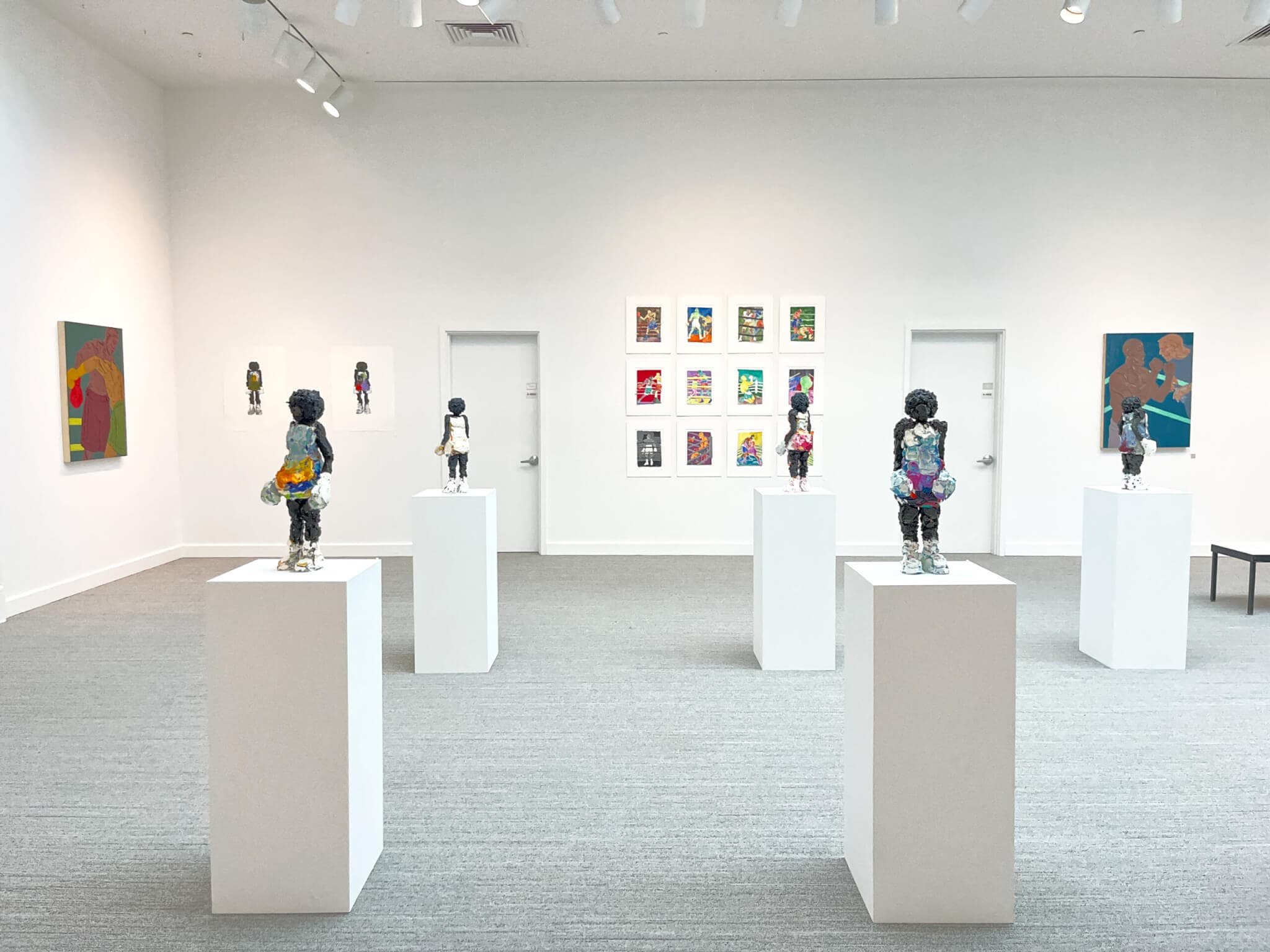
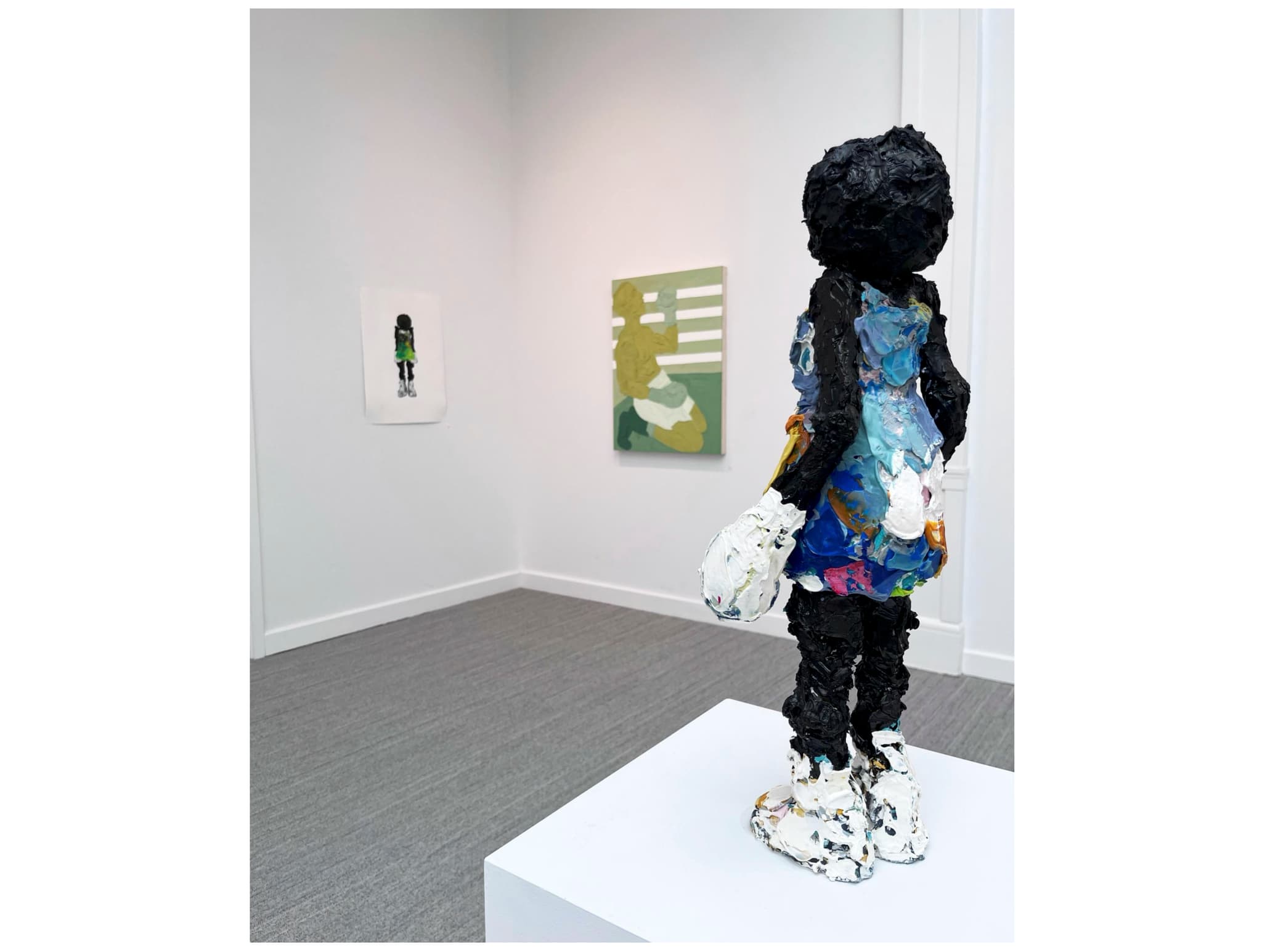
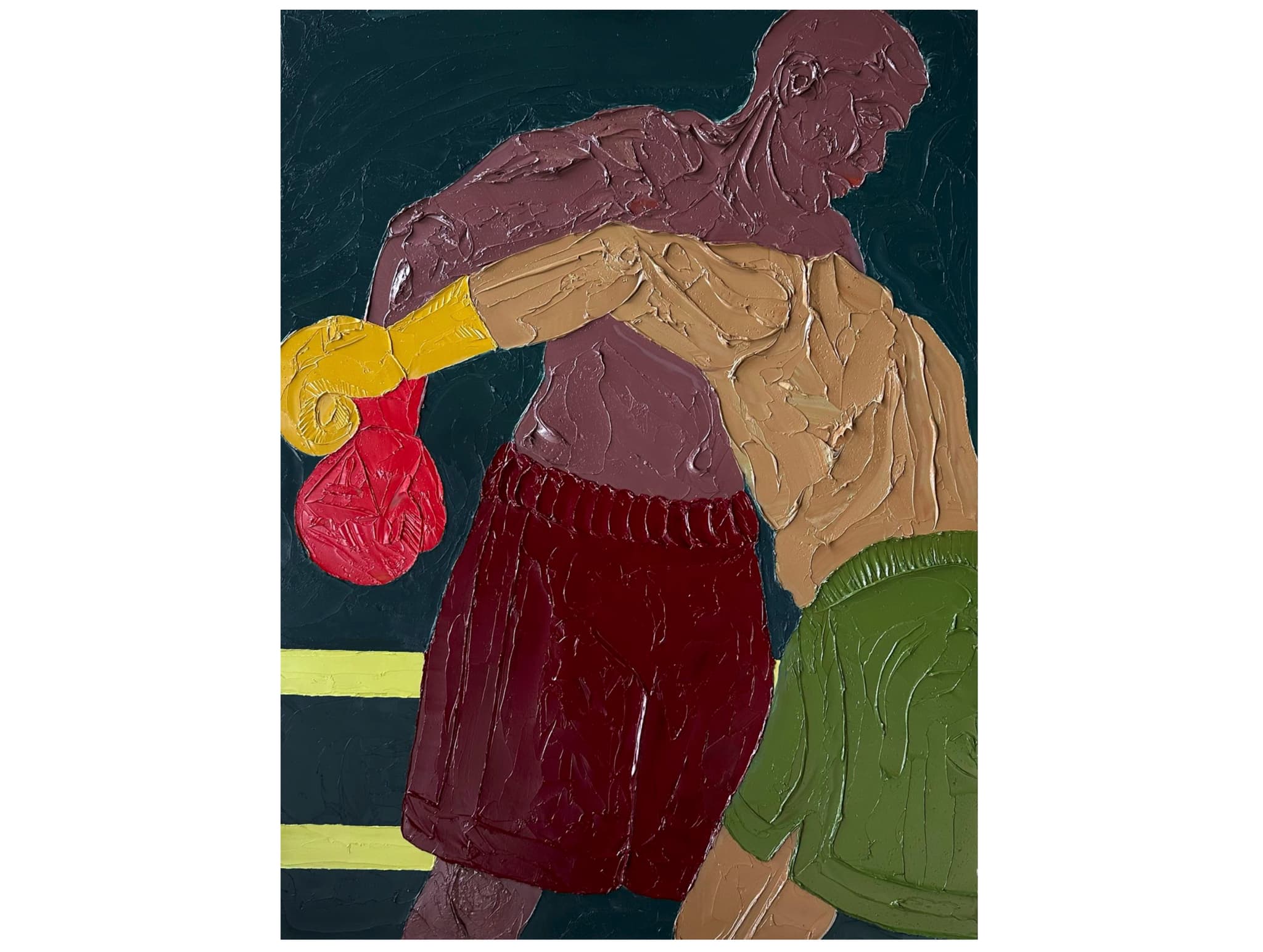
Jenkins is widely recognized for his three-dimensional paintings that use multiple layers of oil paint to achieve gestural, abstract forms. In his recent works on view in the exhibition, Jenkins presents a series of female figures as sculptural paintings and works on paper, intended as material proxies for everyday and famous Black women. The works are smaller in scale, standing roughly twenty-one-inches tall, but are materially and conceptually grounded, conveying ideas of vigilance and self-defense. The sculptures are placed in the center of the room like guardians or protectors, anchored by oversized boxing gloves that point defiantly downward. In Keryan’s series of paintings, she traverses Boston’s boxing community, reflecting the artist’s extensive research into local boxing gyms. She portrays these real-life boxers not as illustrative portraits but as subjects through which to engage with broader interrogations of masculinity, race, and class.
Metaphorically speaking, entering the Trustman Art Gallery is like stepping into the boxing ring. As with the sport, the exhibition’s strength lies in the relationship between energetic movement and dynamic stasis, exemplified in sightlines that include Keryan’s Faith; Tommy The Kid O’Toole (2026) and Jenkins’s Fighter Golem (Nina) and Fighter Golem (Iman) (both 2026) that contrast visual jabs and throws with more stoic images of strength. Jenkins’s series of heavily impastoed sculptures, set on pedestals in the center of the room, and Keryan’s Combat (2026), a grid of collaged works on the adjacent wall, similarly complement the artists’ use of color, texture, and gesture.
Keryan and Jenkins correlate the discipline and rigor of boxing with that of art-making. Both practices are physically and mentally demanding, requiring significant time, ritual, action, and sacrifice. While the artists’ compositional strategies and conceptual approaches differ, they share a tactile and rigorous engagement with their materials. Their respective surfaces reveal dense accumulations of paint or paper where the tools of art-making, like brushes and palette knives, are indexical marks of the artist’s hand, like the boxer’s gloves that leave lasting marks on the body. These material strategies are not incidental but cohere conceptually in the representation of the body; the paint imbues the figures with material solidity, evoking ideas of inner strength and self-determination. While Jenkins takes the layering effect into three dimensions, Keryan, too, employs a similar application to a more subtle effect. Works such as Keryan’s forceful painting Dominance; Bernard Renzel Joseph (2026) is a contortion of two bodies in the throws of choreographed jabs and punches. Thick applications of paint appear to cohere the figures into one, skin-to-skin, in an act of physical intimacy.
The fighter’s narrative is often that of an underdog, a marginal figure rising up against all odds to achieve either a surprising victory or a crushing defeat. The press release describes “Misfits” as those who go against the grain of culture and society, a characteristic of both boxers and artists. However, the artists and their subjects here come across not as outsiders but as fitting role models for our times. In the numerous exhibitions that take on contemporary cultural politics, “Misfits” feels remarkably fresh and unexpected.
“Misfits” is on view through May 7, 2026, at Simmons University’s Trustman Art Gallery, 300 Fenway, Boston, MA.